Coordinated Observations of Nebulae in the Central Molecular Zone Exploring gas Recycling and Transformation
CONCERT connects the turbulent, magnetized cloud environment of the Galactic Center to the small-scale physics of filaments, dense cores, disks, streamers, and protostellar feedback.
Large programs such as CMZoom and ACES give the community the wide-area view. CONCERT deliberately goes deeper and finer on a small, carefully chosen sample so that the same clouds can be followed from parsec-scale gas flows down to dense cores and 100 AU-scale disk structures.
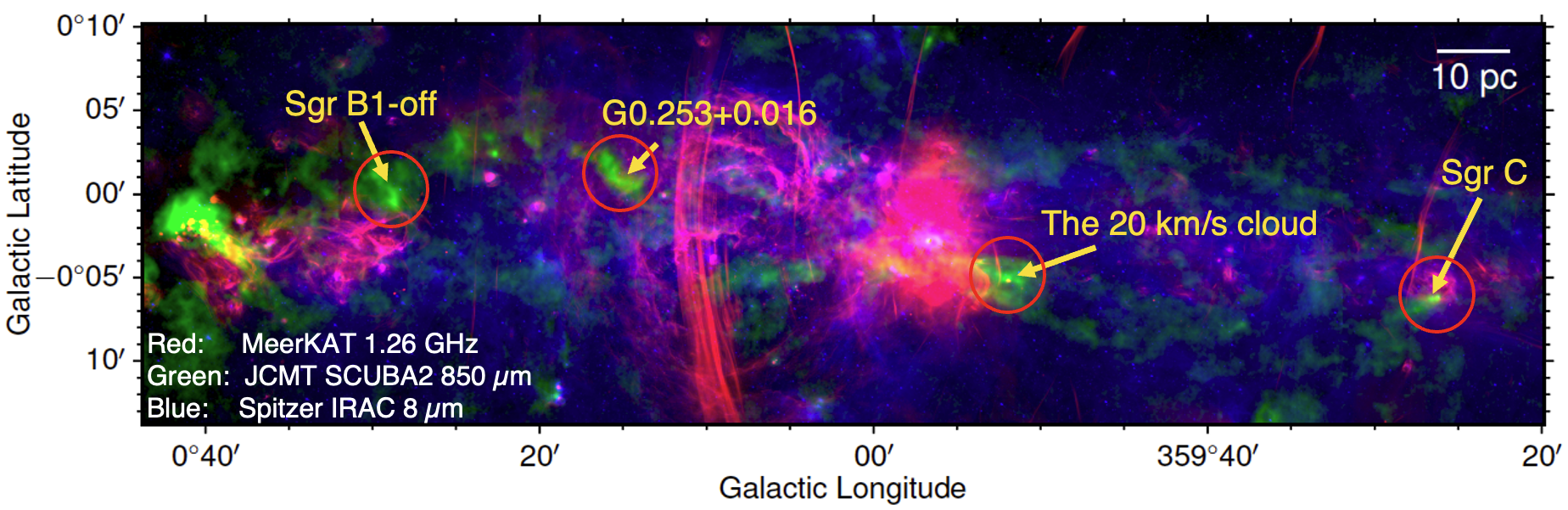
CONCERT focuses on four selected clouds across the Central Molecular Zone: clouds e/f, G0.253+0.016, the 20 km/s cloud, and Sgr C.
Clouds
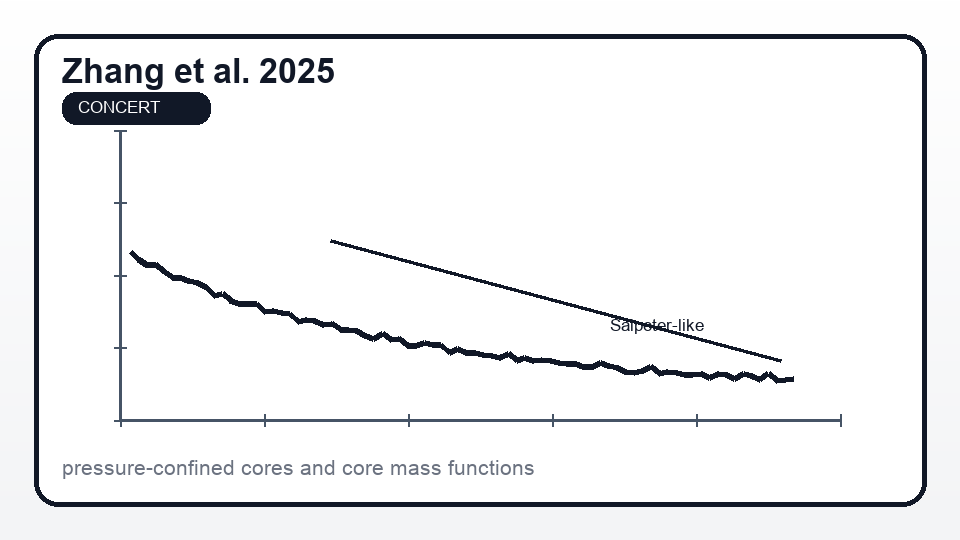
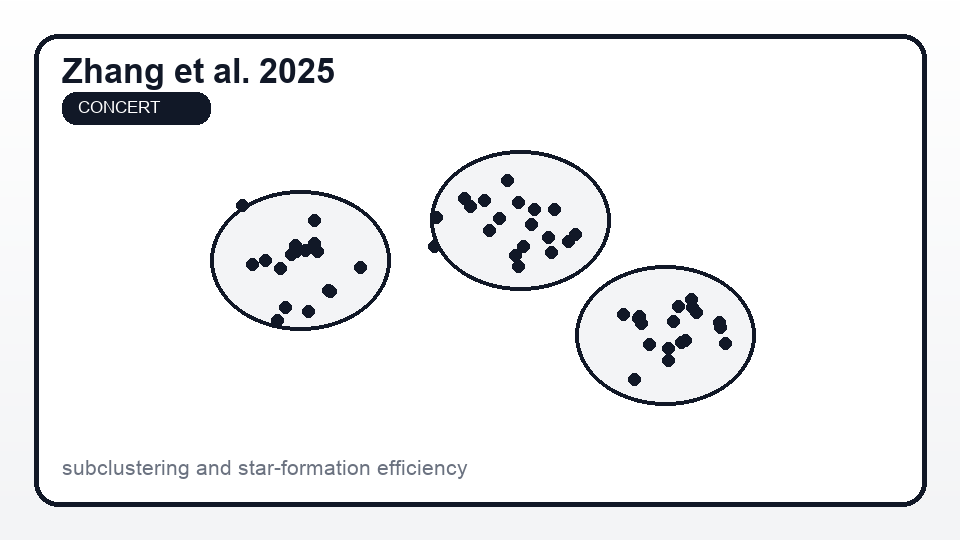
Measure fragmentation, pressure confinement, density structure, and cloud-wide source populations.
Filaments
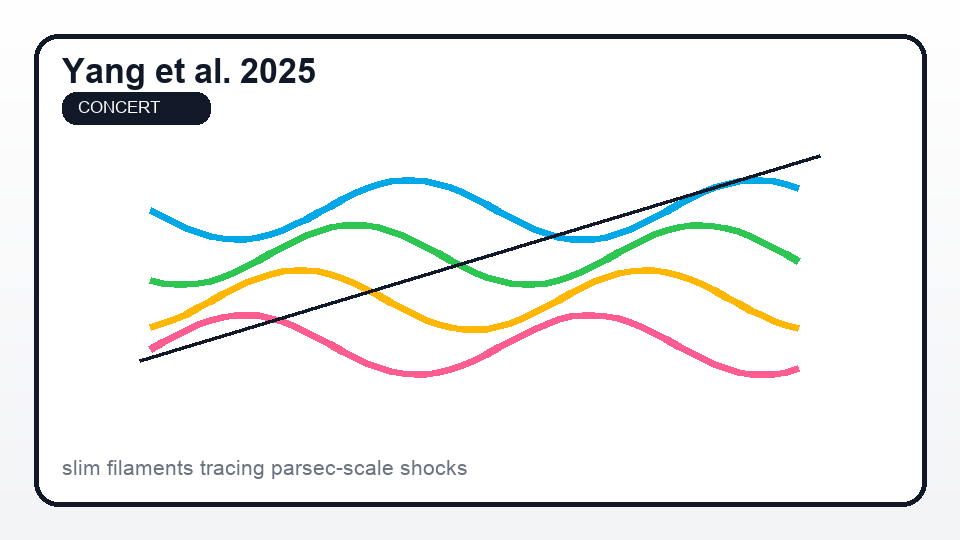
Identify shocks, absorption structures, HNCO fibers, and gas reservoirs feeding dense structures.
Cores
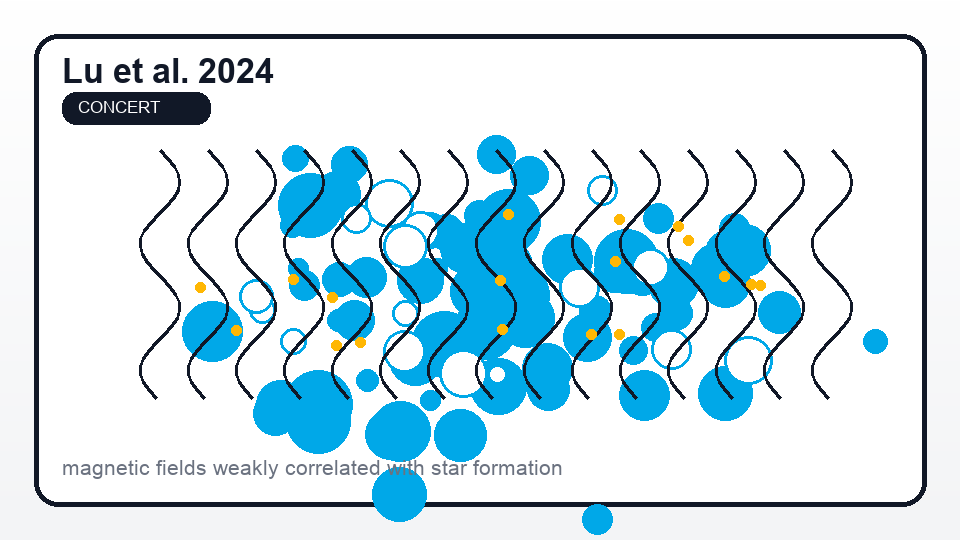
Connect core mass functions, outflows, magnetic fields, and local gravitational flows.
Disks
Resolve rotating disks, envelopes, spirals, and streamers around massive protostars.
The working hypothesis
The CMZ environment is exotic: high turbulence, high pressure, strong tidal fields, complex line-of-sight structure, and dynamically important magnetic fields make the clouds look very different from Galactic disk clouds.
The microphysics may still be familiar: when CONCERT reaches core and disk scales, the basic ingredients of massive star formation - fragmentation, infall, rotation, outflows, and magnetic regulation - still appear to operate.
The key is connection across scales: each publication answers one scale-dependent question, but the campaign is designed so the answers feed into one coherent picture of gas recycling and transformation in the CMZ.
Programs
Named subcampaigns and how they fit together
CONCERT uses a music-inspired naming scheme for focused observing and synthesis programs. The expanded names below show the role of each subcampaign: characterize the gas, find hidden reservoirs, measure magnetic forces, follow gas into disks, and harmonize unconnected CMZ surveys for joint studies of outflows, dense cores, and filaments.
QUARTET
Quad-band excitation mapping
Quad-band ALMA mapping of CMZ cloud excitation and structure
Four ALMA bands toward selected CMZ clouds, with 12-m, 7-m, and TP data, are designed to sample gas density and temperature from cloud to core scales. This program connects physical conditions to N-PDFs and core mass functions.
Related publications
Publication in preparation; no published paper in the current list yet.
MAZURKA
Molecular absorption and hidden gas
Molecular absorption and H I self-absorption kinematics with ALMA
CO and related absorption filaments reveal gas that can be missed in emission-only views. These structures test whether foreground reservoirs, self-absorption, and shocks reshape the apparent CMZ cloud structure.
Related publications
Publication in preparation; no published paper in the current list yet.
POLKA
Polarization of cores and disks
Polarization of cores and disks in the Central Molecular Zone
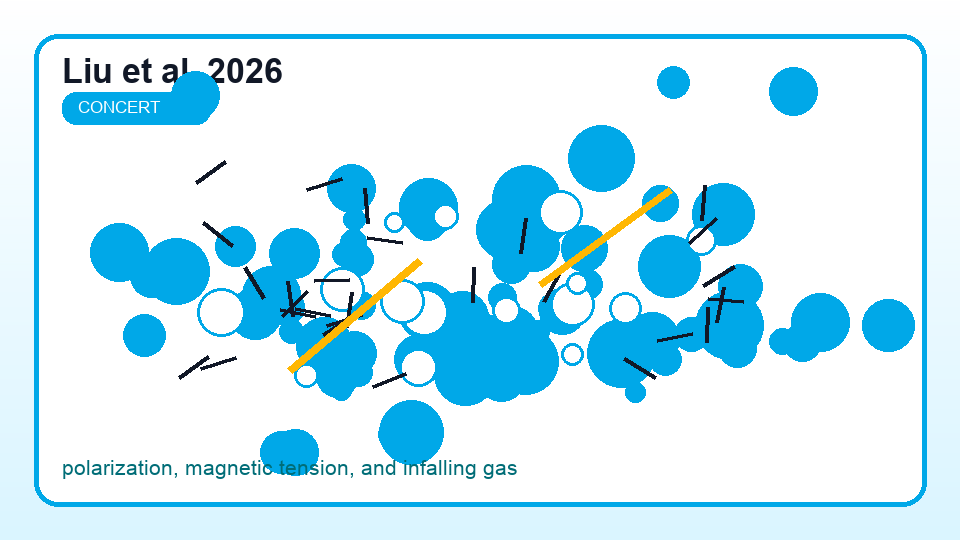
ALMA Band 7 polarization resolves magnetic fields around dense cores. The goal is to compare magnetic tension, gravity, and turbulent distortion where gas is actively moving into cores.
Broadband ALMA long-baseline look-in at accretion disks
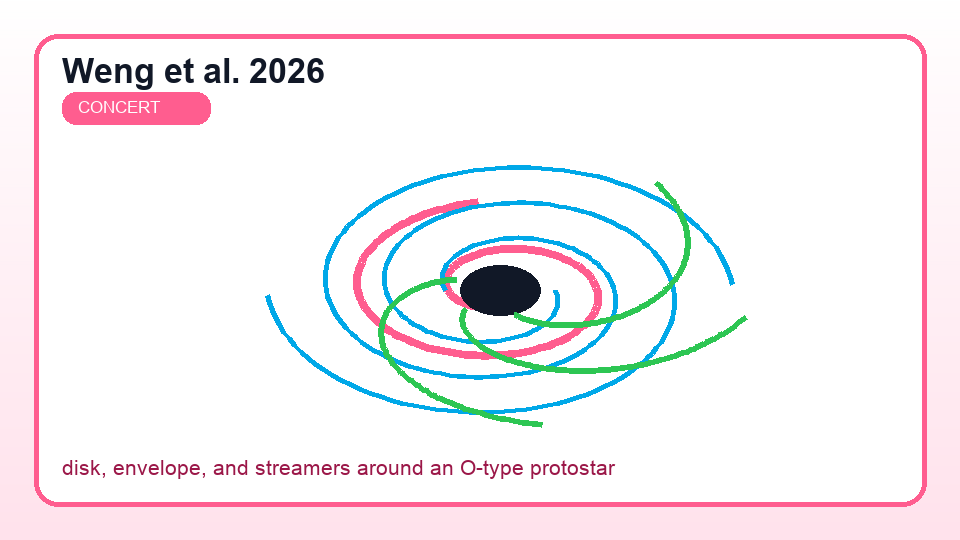
Long-baseline ALMA observations use line forests and continuum structure to separate disks, envelopes, spirals, and streamers around massive protostars in the CMZ.
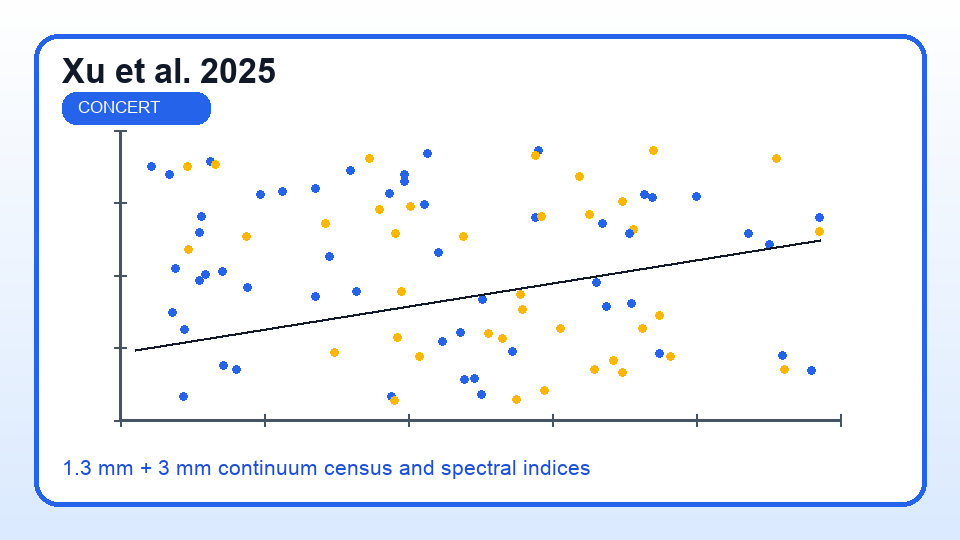
Matched 1.3 mm and 3 mm observations provide cloud-wide spectral indices and a source census, linking dust cores, free-free emission, and evolutionary stage across multiple CMZ clouds.
Coordinated HOmogenized Reanalysis of Unconnected Surveys of the CMZ
CHORUS collects data from different observational projects and brings them onto a common footing, enabling synergistic studies of outflows, dense cores, and filaments across the CMZ.
Related publications
Publication in preparation; no published paper in the current list yet.
Publication Map
How the papers connect
The publication map is organized by the question each paper answers. It begins with foundation papers that define the CMZ star-formation problem, then follows the CONCERT sequence from cloud-scale structure to disk-scale accretion.
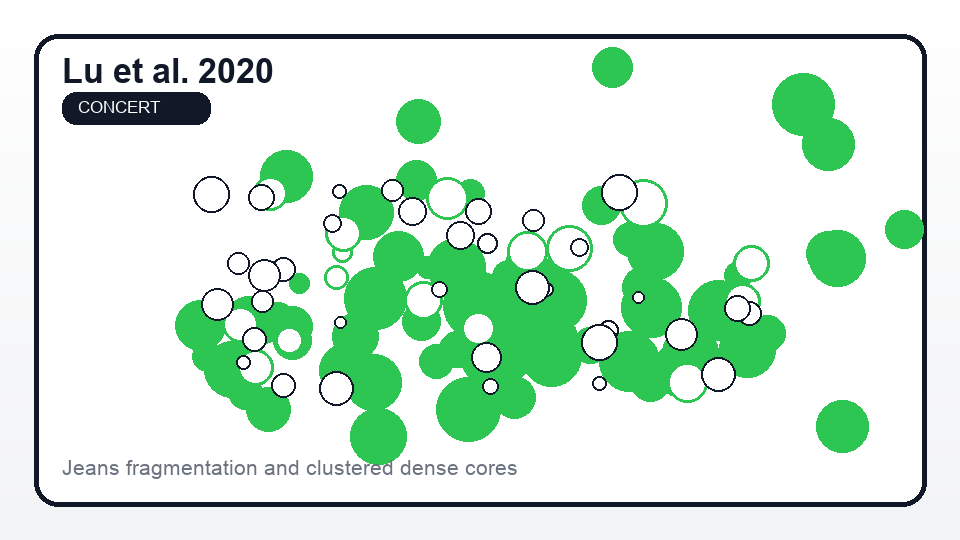
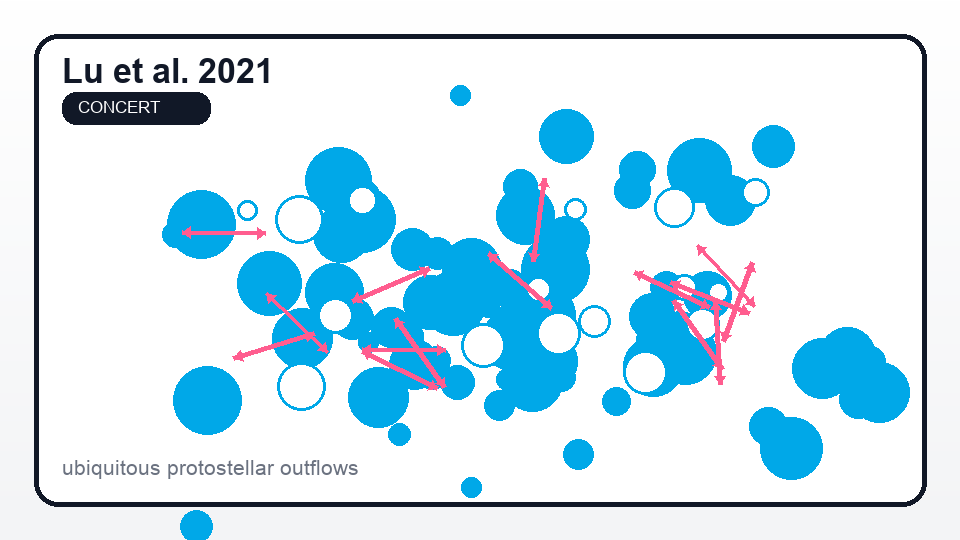
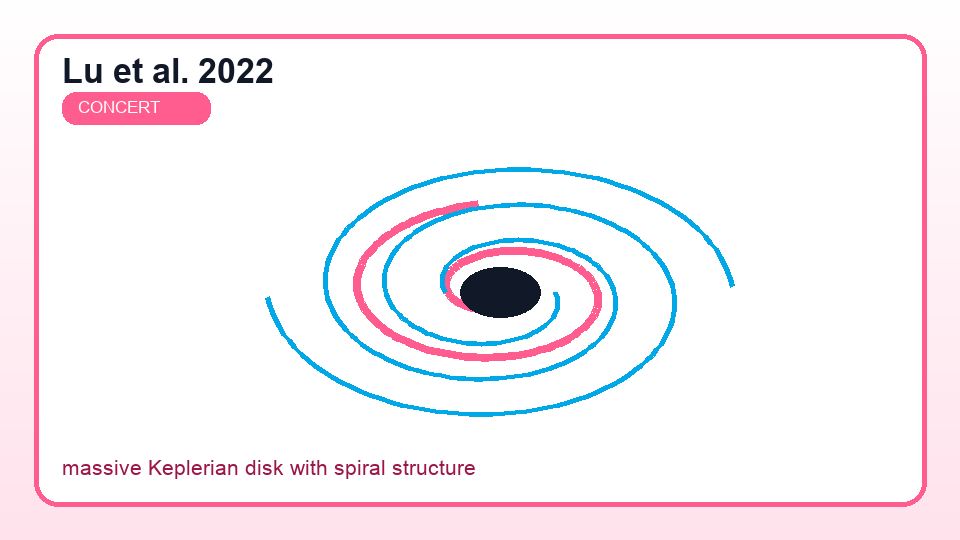
Reading the sequence: the 2015-2019 papers establish the 20 km/s cloud, CMZ star-formation rates, and the early-phase census. The CONCERT sequence then adds fragmentation, outflows, core statistics, filaments, continuum source populations, protocluster assembly, magnetic forces, and disk/envelope/streamer systems. The campaign is therefore a connected argument, not a set of isolated case studies.
Context
How CONCERT complements wide-field CMZ surveys
ACES and CMZoom provide the map
Wide-field surveys define the CMZ environment, identify filaments and source populations, and provide comparison samples.
CONCERT provides depth
Deep, matched-resolution, multi-band observations of selected clouds allow physical conditions, magnetic fields, and disk-scale structures to be studied in the same targets.
CHORUS harmonizes disconnected surveys
CHORUS gathers products from separate CMZ observing projects and reanalyzes them consistently, so outflows, dense cores, and filaments can be compared as parts of one ecosystem.
The synthesis tests universality
The emerging picture is that star-formation microphysics still works in the CMZ, but the extreme environment changes the boundary conditions and makes the same physics appear unusual.
Team
Core team and collaborators
The visible team list below includes collaborators represented in the current CONCERT publication list, as well as researchers actively working on CONCERT papers. CONCERT remains open to anyone interested in the campaign; please contact xinglu@shao.ac.cn if you would like to get involved.